
What’s the difference between a resume and CV? Are robots reading my resume? Find the answers to these questions and more in this post! Plus, download a free resume template.
What is a resume?

A resume is a formal document used in an employer’s hiring process to help determine the ability of an individual to do a job. Individuals use the resume to share their professional qualifications, contact information, education history, work experience, and skills. Employers review the resume to determine that the minimum and/or preferred qualifications in their job description are met. Almost all jobs you apply for will require you to submit a resume, which is why it is so important to understand what to include on your resume and how to format it. Most commonly, resumes are one page in length, however, 2-page resumes are becoming more common for mid-level and high-level positions.
What is a CV?
A CV, or curriculum vitae, is similar to a resume in that it’s function is the same, though the formatting looks a bit different. Individuals still use the CV to share their professional qualifications, contact information, education history, work experience, and skills, but it is often much longer than a resume. CV’s typically include more headers such as classes taught, publications, grants awarded, and more. CV’s are most common in the field of Higher Education but may also be used for high level job positions, such as a CEO. CV’s vary greatly in length and it is not uncommon to see a 5-7 page CV. You should only submit a CV if asked for one, otherwise a resume is the standard in the U.S.
Throughout this article, I am going to continue to focus on resumes as they are more commonly used, however, all of these tips and tricks are relevant for your CV as well!
Note: In many European countries “CV” is considered a synonym for resume. This is not the case in the U.S. so pay attention to what countries you are applying in and what documents are requested.
What goes on my resume and how do I make sure it gets noticed?
There are a LOT of things that could go on your resume. Your resume should ALWAYS include your name, contact information, and work history. It may also include:
- Education
- Volunteer experience
- Hobbies
- Soft skills
- Professional development
- Certifications
- Leadership roles
- Publications
- Relevant coursework
- Mentoring experience
- Special projects
- Honors and awards
- Presentations
- Relevant trainings
- Technical skills
What you include on your resume will vary greatly by the industry you work in and each resume should be tailored specifically to the job you are applying for.
A note regarding contact information: It is becoming less common to include a physical address as it is often considered neutral at best and a negative at worst. The physical address does not provide your employer with any information regarding your experience, skills, and interest in the position. It can, however, provide your employers with details on the distance you’d commute to work, whether or not you are relocating for a position, and even the socioeconomic status of the neighborhood in which you live, all of which have the potential to negatively impact your search.
Many folks create one resume and call it good, submitting it to every job they apply for. While this saves you time, you risk losing job offers. The foundation of your resume is typically going to be the same, after all, your education, work experience, and contact information isn’t different just because you are applying for a different job. However, the way you present that information will change depending on the position, industry, and most importantly, the minimum and preferred requirements from the job description.
Each resume should be tailored specifically to the job you are applying for.
Whenever someone asks me to review their resume, the first thing I ask for is the job description of the position they are currently applying for. I have served on hiring committees for positions from seasonal, high school employees in an escape room all the way to tenured-track faculty members at large universities. While the hiring process varies greatly, the first step is always the same. I sit down with a stack of resumes in front of me, a glass of strawberry milk (I am allergic to coffee!), and I skim those resumes to identify which meet the minimum qualifications. The easiest way you can ensure that your resume stays out of the “no” pile, is to ensure that it is as easy as possible for the hiring person to find these qualifications within the resume. This means the most relevant information, as determined by the job description, should appear prominently on your resume. It also means you should not get fancy with a thesaurus. Instead, you should use the same language the employer uses, especially if you suspect they may use an Applicant Tracking System (more details in a later section!).
The most relevant information, as determined by the job description, should appear prominently on your resume
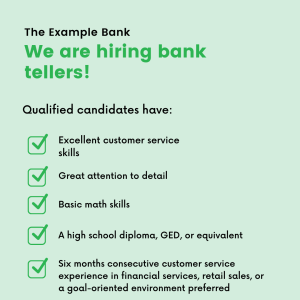
For example, on several resume templates you will see that there is a location to list skills. Based on the job description provided here, which list of skills is better suited for the applicants resume?
We are hiring bank tellers! Qualified candidates have excellent customer service skills, great attention to detail, basic math skills, and a high school diploma (or equivalent). Six months of consecutive customer service experience in financial services, retail sales, or a goal-oriented environment preferred.
Resume Skills List 1
- Microsoft excel
- Team-work
- Customer service
- Creativity
- Attention to detail
- Accounting
Resume Skills List 2
- 2 years of customer service in retail sales
- Accounting
- Attention to detail
- Team-work
- Microsoft excel
The first list was created for a general resume to be sent out with all job applications. The second list was rearranged after viewing the specific job description. Though both lists have the same information, the second list was modified to add more detail and rearranged to include the requirements near the top. The same tip will apply to the bullet points listed in your work experience and even which headers appear at the top.
For example, if a job description emphasizes a bachelor’s degree and a specific license in the minimum requirements, then your education should appear at the top. Alternatively, if a job description doesn’t have any mention of education and instead emphasizes customer service experience, then your work history that includes customer service should appear at the top and education can be moved down.
What should NOT go on my resume?
This largely depends on the type of position you are applying for, but here are some general tips.
NEVER include information that is false or misleading. This is commonly seen in language proficiencies. If you list “fluent in Spanish” on your resume, you should be prepared to conduct the entirety of your interview in Spanish. If you are unable to do that, then you would not be considered fluent in Spanish and should consider different wording to describe your Spanish experience. The Interagency Roundtable Scale in the U.S.A. uses these levels of proficiency: elementary proficiency (S-1), limited working proficiency (S-2), professional working proficiency (S-3), full professional proficiency (S-4) and native or bilingual proficiency (S-5). Another example is proficiency with various software programs or coding languages. If you list these items on your resume, you should be prepared to demonstrate them at the level you described in an interview.
NEVER include information that is false or misleading.
In general, you should not include information that is irrelevant or outdated, however, this is fairly subjective. As a high schooler, you may have minimal experience to include on a resume so it is more common to list athletic teams, club involvement, and domestic jobs such as babysitting. As you go into college and the professional world, however, these items become outdated and should be dropped off the resume as you gain more experience. Similarly, your resume should not include items that are irrelevant. There is a really great “How I Met Your Mother” episode in which all of the characters reveal that they have experiences including Hot Dog Eating Contest Winner, Basketball Dunking Champion, and College Late Night DJ listed on their resume. None of these items are related to their chosen professions and are therefore kicked off the resume. While I really love escape rooms and enjoyed working as a Game Room Master in college, it’s not something I list on my professional resume for higher education positions.
Usually, hobbies and interests do not go on your resume, however, this is largely determined by their relevancy to the job as discussed in the previous paragraph. While hot dog eating may be a hobby of yours, it doesn’t belong on your resume if you are applying for positions as a bank teller. Alternatively, if you are a hobby woodcarver looking to get an apprenticeship in wood working, that absolutely could appear on your resume.
How do I format my resume?
There is a LOT to consider here and it doesn’t translate well to a narrative so I am going to break it down as simply as I can and let the sample templates do the rest of the talking for me!
- Submit resumes as a word document (unless other formats are listed as preferred)
- Use web-standard fonts: Arial, Tahoma, Verdana
- Fonts should be between 10pt and 12pt, except for your name which can appear larger
- Only 1-2 fonts should be used
- It is standard for font to appear in black, however, adding an accent color is becoming more common. Do not include many different colors.
- Use margins between .5-1″
- Contact information should appear at the top of the resume
- For bullet points, use the structure [Action Verb + Task & Details + Result]
Are robots really reading my resume?
Yes! Robots are reading your resume.
Okay, they aren’t exactly robots, they are called “Applicant Tracking Systems.” The ATS is created with specific keyword recognition and algorithms to find applicants who meet their requirements, and may rank them in a hierarchy of most qualified applicants. Research from Jobscan claims that over 98% of Fortune 500 companies use an ATS of some kind. This should not come as a surprise when you consider companies like Google get around 75,000 applicants each week!
Remember earlier when we said you want it to be as easy as possible for someone to locate the minimum and preferred qualifications in your resume? This is also true for ATS. An Applicant Tracking System may not recognize your qualifications if it appears too differently from what the system is programmed to search for. For example, if you list LPN on your resume, but the ATS is programmed to search for “Licensed Practical Nurse,” you may be moved down in the list of qualified applicants. The Muse suggests writing out both the full name and adding the abbreviation in parenthesis to ensure those pesky robots can find you.
An Applicant Tracking System may not recognize your qualifications if it appears too differently from what the system is programmed to search for.
So what else can you do to appease your new robot overlords? Well, you can include an executive summary at the top of your resume which includes key words from the job description, use key words in all of your bullet points, and use web-standard fonts such as Arial. Avoid getting too wild with your formatting, using abbreviations (ex. Mgr. instead of Manager), avoid graphics, and do not include important keywords in headers or footers. ATS are most proficient in reading Microsoft word documents but you should always use the preferred formatting listed in the job posting.
Thank you for stopping by my blog to learn more about resumes and good luck on your job hunt! If you are interested in having your resume reviewed by me, check out my services page. You can submit your resume for written feedback or we can go over it together live over zoom using the share screen function.
 Tayler Mercil