Essays, videos, resumes, oh my! What to know when it’s time to apply.
When I begin working with high school students on applying for scholarships, I tell them that when I was in high school, I spent an average of 3-5 hours per week applying for scholarships from August-March. At first, they collectively agree that this is way too much time. If they’re really motivated, they will do the math and exclaim, “That’s over 150 hours!” and I will counter, “Yes, but if I spend five hours applying for scholarships and win just one $500 scholarship in those five hours, I am getting paid $100 an hour and I think that’s pretty good.” For most scholarships, $500 is the smallest award. Many have awards of $1,000, $5,000, and even $25,000. While I admit that 5 hours a week was quite a bit, that dedication allowed me to make it through my bachelor’s and master’s degrees debt free! This post will go over what you can expect from a scholarship application as well as things you need to know when applying. If you instead want to learn where to find scholarships, click here.

Eligibility
When applying for scholarships, the first thing you need to understand is the eligibility requirements of the scholarship. The eligibility requirements are determined by the funder (the person who is providing the money to the scholarship award) and outline the type of person they want the award to go to. They will select a student based on their personal attributes, experiences, goals, or other qualities of the student. Common eligibility requirements include high school grade point average, financial need, location of residence, participation in extra-curriculars, and area of study. Take a look at the sample eligibility requirements below and see if you are eligible for one or more of the mock scholarships below.
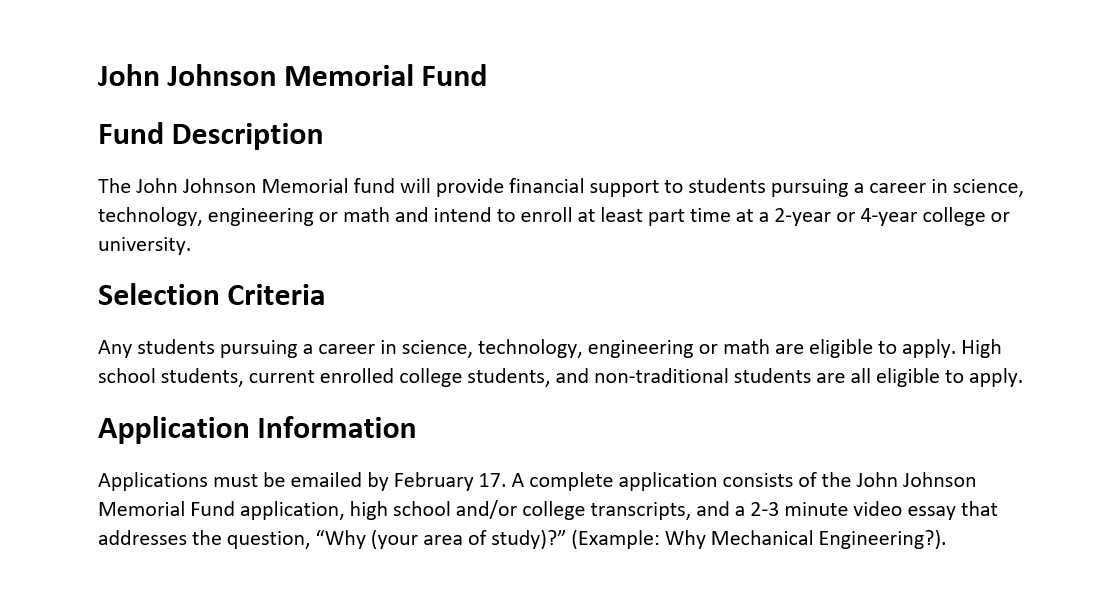

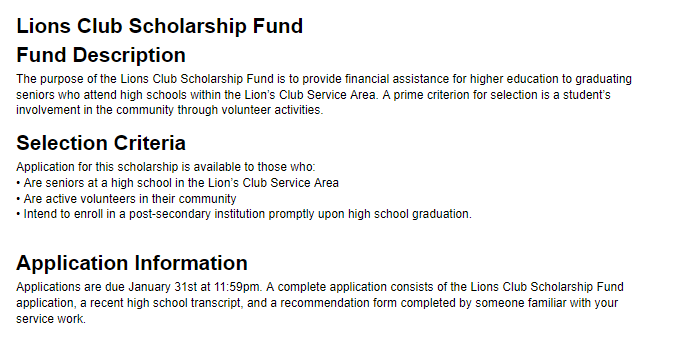
You may meet all of the requirements, some of the requirements, or none of the requirements for these mock scholarships. These eligibility requirements are enforced by a scholarship committee, whose job is to select a winner of the award that the donor (person who funds the award) would approve of. In larger, national scholarships your first reviewer is likely to be a computer. This means if the required GPA is 3.5, anyone with a GPA lower than 3.5 will be automatically removed from the pool that gets forwarded to the scholarship committee. For these types of awards, it is best to only apply if you meet ALL of the eligibility requirements.
Pro tip: You can (and should!) apply for local scholarships, even if you don’t meet all of the application criteria.
On the other hand, for smaller, local scholarships, your application is more likely to be read by a person on the first time around. This may provide you with a bit more flexibility. If the scholarship has a small application pool, and the committee wants to give out a certain number of awards this year, you may still have a chance to get the award even if you don’t meet all of the requirements. For example, let’s say only ten students applied to the Sports Legacy scholarship and of those ten, only three people who applied met all of the eligibility requirements. If the scholarship committee wants to give five awards this year, they will be considering the remaining seven students for the award. This means folks who are just under the GPA requirement of 2.5 or who are junior varsity athletes may still have a chance of winning the award. Keep in mind, the scholarship committee is trying to choose someone that is a good fit for their scholarship. Do not waste their time and your time by applying for scholarships you are not even remotely qualified for. If the scholarship is for music majors and you are a nursing major, that scholarship is not for you. However, if that scholarship is for students that plan to “study music” and you are going to minor in music, go for it!
One of the biggest ways to determine if there is flexibility in the scholarship committees decision is the word “preferred” appearing in the application. This means that while they have a specific type of candidate in mind, they are still willing to accept other candidates. Often, you will see preferences surrounding race, gender, or religion. Let’s say that the John Johnson Memorial Fund earlier is funded by a Catholic church. That committee may have a statement such as, “Preference will be given to members of the Catholic church.” That means preference will go to Catholic applicants, but it does not mean that folks who identify with another religion would be ineligible to win. Ultimately, it is up to you if you want to apply for scholarships that you may be on the edge of meeting one or more requirements. If it is a short application that you’ve already got materials for it prepared, absolutely go for it! However, if it will take several hours of your time or you are confident it’s an award that will have many applicants, you may choose to focus that time elsewhere.
Applications
The foundation of scholarship applications are essentially the same. Most applications will include: contact information (email, phone number, address), academic information (GPA, ACT score), school activities (sports, clubs, groups), community activities (volunteer work, religious groups, clubs/teams), work history, and college information (where you will attend, what you will study). Though slightly less common, they may also request: parent contact information, honors/awards, research experience, etc.
I recommend completing this generic scholarship application below so that you have ALL of the information in one place allowing you to copy and paste these items instead of re-typing them for every application.
Outside of the application itself, most will require one or more of the following: a personal statement, a written or video essay, transcripts, resume, letters of recommendation or recommendation forms, and financial information, such as reporting certain pages from the FAFSA.
Essay and Video Questions
Most scholarship applications will have at least one essay or video component. This is how the scholarship committee gets to know you on a more personal level than just a list of your achievements and activities.

The most common form of this essay is what is often called a “personal statement.” A personal statement is an essay that gives the reader a sense of who you are, including your accomplishments, goals, and why they should invest time and money in your education. A good personal statement includes elements of story that make you stand out in a pool of applicants with similar qualifications. Any student can write, “I have always wanted to study public relations” but very few could write truthfully, “If I had not sung “Let it Go” dressed as Disney’s Queen Elsa in front of 40 wide-eyed and probably sticky children, I would never have found public relations.” The first sentence tells the reader that I want to study public relations. The second sentence, taken from my graduate school application to Western Michigan University, tells the reader I want to study public relations and I’ve got an interesting story to tell about it. It shows that I have public relations experience, that I sing, that I do some sort of service work with children, and, most importantly, that if they read on they will get to hear more. Personal statements are often the toughest form of essay to write because it can be hard to summarize yourself in an interesting and compelling way, which is why it’s the most common support request I get!
Pro tip: Save a copy of every essay and short answer response you write! Label them clearly in a folder so that you can copy, paste, and edit instead of writing something totally new each time.
In addition to the personal statement, there are several other essay topics you will see consistently across applications. For this reason, it’s important that you save a copy of every essay you write. This will allow you to pull from essays that are already written, instead of re-writing a new essay each time you apply for a scholarship. Here are the most common essay questions I see on scholarship applications today:
Education and Career
- Where do you see your career in ten years?
- What are your academic and career goals?
- Why do you want to study _________?
- How will your study of _______ contribute to your immediate or long range career plans?
- Explain the importance of (your major) in today’s society.
Personal Experience
- What impact has _______ had on your life? (work, sports participation, music, etc.)
- How have you contributed selflessly to your community?
- What’s the most difficult challenge you’ve ever faced? How did you handle it?
- Who in your life has been your biggest influence and why?
- Describe how you have demonstrated leadership ability both in and out of school.
Other
- Why do you deserve this scholarship?
- Is there anything else you want the scholarship committee to know?
Hopefully you’ve already noticed that many of these questions are similar in content and themes. Your essay on your career in ten years should absolutely address your academic and career goals. Your essay on what impact competitive soccer has had on your life should address how you have demonstrated leadership. These essays will vary in the way you address the question, but a lot of the meat will be the same and can be pulled into your next essay. In my scholarship advising sessions with high school students, we write a LOT of essays the first two months. Then all of a sudden, we get to scholarships where the student exclaims, “Hey, I already wrote that essay!” So instead of writing something new, we are making small changes to fit the new scholarships criteria. Now, we’ve gone from a scholarship application taking several hours to complete, to taking only 20 minutes. The scholarship journey is daunting at first, but when you hit this point you will feel so great!
Letters of Recommendation
Scholarship applications will commonly require letters of recommendation or recommendation forms. Often, the scholarship description will specify who should write this letter and other times they will leave it up to you! When it can be anyone, how do you choose? Here are a few tips to choosing your letter writers and a few other tips to keep in mind.
Timeline
One of the greatest barriers to getting your letter of recommendation is your timeline. When requesting a letter of recommendation, it is common courtesy to send the request at least three weeks in advance of the scholarship deadline. For some letter writers, they may refuse to write your letter without at least that much time. However, there may be times that you find a new scholarship and realize it is due by the end of the week. In these instances, it’s important to know who you have on your team that could write a letter quickly and still do a great job. Further, you might consider who is responsible for their timeline. When you ask this person to get something done, do you trust they will get it done on time? Or, is this someone you need to send multiple reminders to?
Relevance
Most scholarships will tell you if they need or want someone specific to write a letter. For example, in our mock Sports Legacy scholarship at least one letter needed to be from a coach. In some scholarships, however, there may be no other instructions other than submitting the form or letter. In these instances, it is up to you to determine who would be a good fit. Here is a list of folks Tucker has determined would be able to write a good letter of recommendation on his behalf:
- Mr. Rodriguez – Calculus teacher, Knowledge Bowl Coach
- Mrs. Kay – Music teacher
- Mx. Thompson – Boss at YMCA
- Tony – Neighbor who I work for in the summer
- Alice – Volunteer Coordinator at the Animal Shelter I volunteer with
Which scholarship Tucker is applying for will greatly impact who he asks to write the letter. Consider the following scenarios: A scholarship for STEM students, a scholarship for students that demonstrate leadership, a scholarship for students active in the community, a scholarship for students participating in the arts. Which writer would you choose for each?
Sample Requests
When sending a request to your scholarship writers, you should always include the name of the scholarship, key elements of the selection criteria, the scholarship deadline, and the key reason you’ve selected this person to write the letter. I also recommend including your personal statement and resume for additional context for the person writing the letter. It is also important to say thank you and give them plenty of advance notice! Here are a few templates you can use for inspiration:
Dear coach Jane,
I am reaching out to you because I am applying for the Sports Legacy Scholarship and I would greatly appreciate if you would write a letter of recommendation for me. I enjoy having you as a coach on the swim team and I have learned so much in my role as team captain. With this in mind, I think you would be able to speak to my leadership abilities and dedication to the team. I have included my current resume which details my participation on the swim team, the tennis team, and my new role as a swim instructor for kids aged 5-10. You can find the scholarship description here and the scholarship deadline is January 1st at 11:59pm. Please let me know if you would be willing to write a positive letter of recommendation for this award.
Sincerely,
Abigail Adams
Dear Mr. Hamilton,
I am applying for the Lion’s Club Scholarship for high school seniors that are active volunteers in the community. This application requests a recommendation form from someone familiar with my volunteer work and I immediately thought of you. I had an amazing time volunteering on your team last summer for the Park Clean Up project. This project inspired me to start a clean-up crew at school for which I am the club president. We get together once a month to pick up litter at school and helped to get new recycling bins in the lunchroom. I have attached my resume which includes more details on this project.
Please let me know if you are willing to complete the attached recommendation form on my behalf. I would especially appreciate if you mention the Volunteer of the Month Award I won in June. The deadline for submitting this form is February 17th.
Thank you for your continued support,
Aaron Anderson
Supporting Documents
Last, but certainly not least, do not forget to submit your supporting documents! I repeat:
DO NOT FORGET TO SUBMIT YOUR SUPPORTING DOCUMENTS
We’ve got the application, the essays, the letters of recommendation, but many scholarships also require copies of your transcripts and/or testing scores. When the application has a space to upload them, it’s usually fairly easy to remember. However, some scholarships may require official transcripts and test scores, which require you to put in a request with your school to have them mailed directly to the scholarship entity. If this is the case, you need to take in additional time consideration for your school to process the request.
Thankfully, many scholarships accept unofficial transcripts and test scores which means you just need to save a copy of those documents and upload, email, or post those items when you submit your application.
Thanks for stopping by my blog today! If you would like me to review your scholarship applications, essays, and beyond, head on over to my services page.
 Tayler Mercil